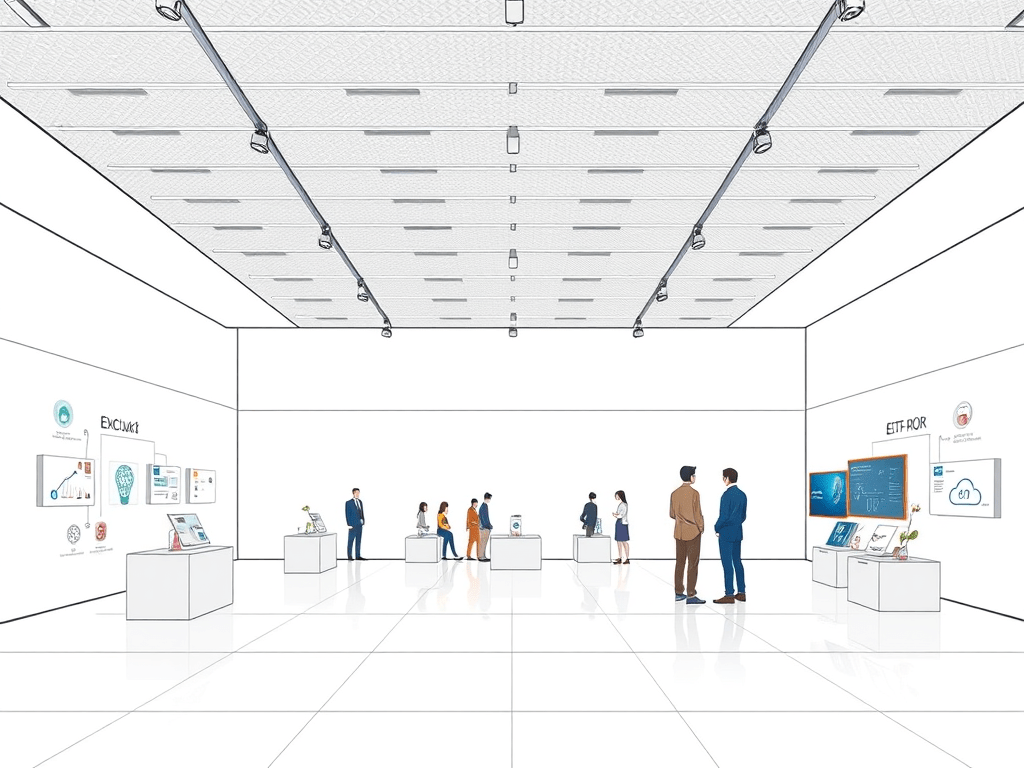
There’s a particular challenge in selling innovation to enterprise customers: the gap between describing what technology can do and letting someone actually experience what it might mean for their business. Slide decks bridge this gap poorly. Demos help, but only if they’re situated in the customer’s reality rather than a vendor’s best-case scenario.
I decided to build the room – a very big one- where that experience could happen — and make it the best of its kind in Asia.
What I Built
I established Asia’s first Customer Experience Center: a premier innovation hub designed to make digital transformation tangible for customers and partners. The center showcased IoT, Machine Learning, Blockchain, Big Data, Analytics, Data Intelligence, and Cloud Platform capabilities — not as isolated demonstrations, but as integrated ingredients for real business transformation, connected to actual enterprise use cases and business outcomes.
The design principle was simple: every exhibit had to be anchored to a customer problem, not a technology feature. A CxO walking through the center shouldn’t leave thinking “that’s impressive technology.” They should leave thinking “I can see how this changes the economics of what I do.”
The Model
The center became a front-end for customer and partner engagement at the most senior level. I led the customer success team and managed the relationships that brought over 500 customer CxOs through the space. We built 50+ business case studies and 60+ live showcases — each designed to accelerate a specific digital transformation conversation, not just open one.
The commercial outcome was significant: the center directly facilitated few hundred millions in sales. But I think the more lasting outcome was the model itself — the proof that positioning a technology company as a transformation partner, rather than a software vendor, produces a qualitatively different kind of customer relationship.
The Leadership Dimension
Building something like this requires a kind of leadership that sits at the intersection of product, technology, customer success, and business development simultaneously. I had to understand what customers needed to see, what our technology actually did at enterprise scale, what our sales teams needed to convert conversations into commitments, and what would make a CxO leave the room having changed their mind about what was possible.
That combination — product and technology credibility combined with commercial instinct and customer empathy — is what the center was built on. And it’s what I believe made it work.
In your customer conversations, how often are you showing what’s possible versus telling? And what would it take to change that ratio?
Let’s keep learning — together.


 harish.balasubramanian
Share your thoughts