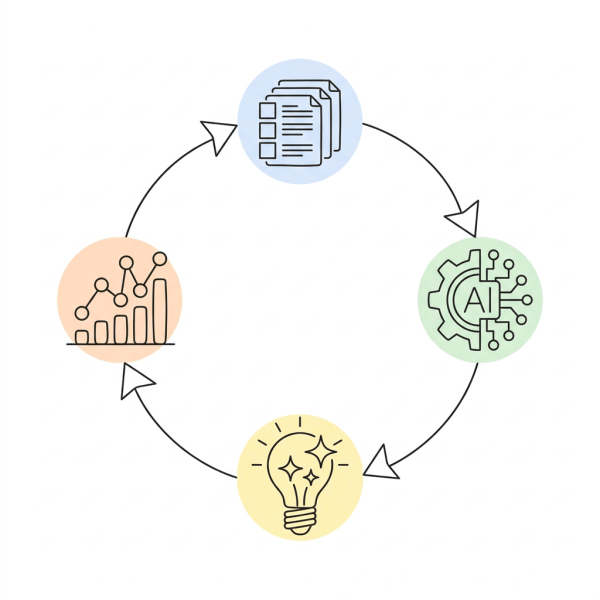
87% of leaders say poor data quality is holding back their AI results. The gap between who closes that loop and who doesn't keeps widening.
The Feedback Loop Isn’t About AI. It’s About What You Feed It.
Learning is forever
87% of leaders say poor data quality is holding back their AI results. The gap between who closes that loop and who doesn't keeps widening.
AI talent is scarcer than ever across every industry — but the scarcest skill isn't building models anymore. It's knowing where AI belongs.

A platform decision looks technical. It's actually a bet on other people's success — and that changes everything about how you build one.

Composable enterprise is no longer a theory — it's a procurement requirement. The technical questions are often the easy part. Here's where organisations actually get stuck.

67% of organisations don't trust their own data for decisions. Yet AI is being built on top of it. That gap is where competitive advantage quietly compounds.

78% of organisations use AI. Public trust in AI companies just dropped. The organisations closing that gap aren't playing defence — they're building an edge.

Composable architecture isn't just an IT pattern. It's a bet that the enterprise of the future needs to be designed for change, not just designed well.

Enterprises are discovering that AI ambitions have a ceiling — and it's set by architecture decisions made a decade ago. The gap is widening fast.

Enterprise AI teams are quietly stepping back from building and moving toward assembling. The shift in how AI gets deployed is more telling than the headline spending numbers.
Enterprise AI crossed a threshold in 2024. The question shifted from "can it work?" to "how do we scale it?" Here's what the year actually proved.

Responsible AI frameworks are everywhere. Implementation is not. The gap between principles and practice is where the hardest decisions actually live.

FTX collapsed in November 2022 with $8.9 billion in customer funds missing. The governance failures weren't hidden — they were hiding in plain sight

Four PMF frameworks — Andreessen, Olsen, 7-Fit, and Sequoia Arc — aren't rivals. They're lenses. Here's how to use them as a diagnostic, not a checkbox
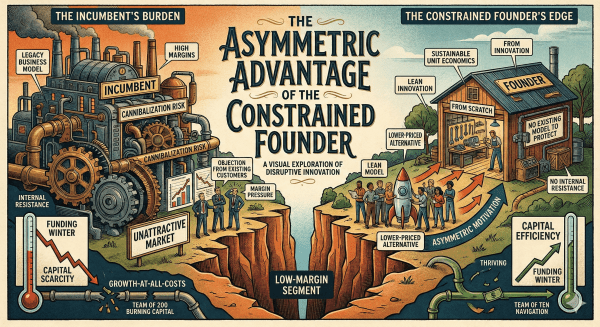
Incumbents retreat during downturns. Markets get abandoned. Segments get underserved. That's not a problem for disruptors — it's their opening
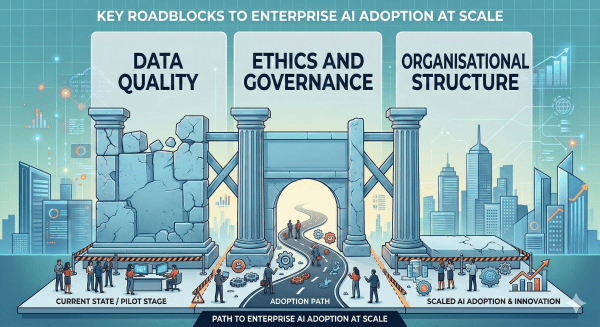
Enterprise enthusiasm for AI is real. So are the three structural barriers preventing it from scaling. Data, ethics, and organisation — here's what's actually in the way.

James Clear's book isn't really about habits. It's about identity. And once you see it that way, the whole system starts to make a lot more sense.

Ben Horowitz doesn't offer a formula for building a business. He offers something rarer — an honest account of what it actually feels like when the formula runs out.
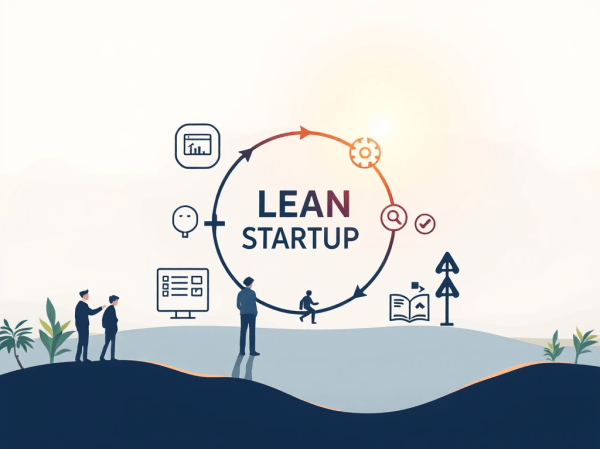
Capital scarcity is doing something useful — forcing founders back to lean discipline. Build, Measure, Learn has never been more relevant than right now.
Most organizations over-invest in incremental improvements and under-invest in transformative ideas. The Innovation Ambition Matrix reveals exactly why — and what to do about it.

Jocko Willink and Leif Babin learned leadership in Ramadi, Iraq — one of the most dangerous places on earth. The principles they brought back turn out to apply almost everywhere else too.

Osterwalder and Pigneur didn't just write about business models — they reinvented how we visualise and challenge them. The Business Model Canvas remains one of the most useful single-page tools in strategy.

Design thinking is everywhere in 2022. But most organizations skip the one phase that actually matters. Here's where the real innovation breakthroughs happen.

The assumption that competitive advantage requires keeping innovation internal is increasingly wrong. The best ideas today live outside organizational boundaries.

Capital is flowing freely, valuations are untethered, and growth trumps profitability. But the smartest founders I know are building like it won't last.

The best innovators aren't chasing every idea — they're managing a disciplined portfolio. Here's the framework separating winners from the rest in 2022

Many enterprises are stuck in AI pilot mode due to three main hurdles: unreliable data stemming from weak governance, a talent shortage in data science, and outdated organizational structures. Successful AI adoption requires treating it as a transformation initiative, investing in data quality, and integrating AI teams with core business functions.

Hsieh didn't just build a shoe company. He built a proof of concept — that culture, not strategy, is the most durable competitive advantage a business can have.

Most people don't have a goal problem. They have an execution problem. The 12 Week Year reframes how time works — and why a year is actually the enemy of getting things done.

Greg McKeown's Essentialism isn't really about doing less. It's about doing the right things — and having the discipline to protect that choice from everything pulling in the opposite direction.

We built our company's first in-house startup accelerator. Some of those startups became unicorns. Here's what that taught us about the difference between watching innovation and enabling it.


You must be logged in to post a comment.