
There are projects you plan carefully. You write the brief, scope the roadmap, align the stakeholders, and build methodically. And then there are projects that arrive like a fire alarm — urgent, unscripted, and entirely unignorable.
Building karnataka fights corona webapp was firmly the second kind.
The Problem That Needed Solving
At the peak of the pandemic, when uncertainty was the only reliable forecast and every institution was scrambling to respond, there was a clear and urgent gap: citizens needed a single, reliable place to access information, find resources, and navigate a crisis that was evolving faster than any communication channel could keep up with.
I decided to do something about it.
I spearheaded the initiative from the ground up — conceiving the product vision, building the team, and assembling an ecosystem of partners who could move at the speed the moment demanded. What came together was a product team of 60: product managers, data scientists, architects, and developers, working alongside corporates, universities, startups, NGOs, and independent developers. I brought each of these pieces together deliberately — not because the resources existed and needed coordinating, but because I went and found them, convinced them of the purpose, and created the conditions for them to contribute.
That kind of team doesn’t assemble itself. It takes a product and technology leader who can hold the vision steady while everything around it is in motion.
What Building Under Pressure Reveals
Leading a cross-functional, multi-stakeholder team in a crisis is a different leadership experience from running a product organisation in normal conditions. The usual scaffolding isn’t there. There’s no established trust, no shared vocabulary, no history of working together. What you have instead is urgency, a shared purpose, and whatever leadership clarity you can project.
The decisions that would ordinarily take weeks happened in hours — not by cutting corners, but because the alignment was genuine and the goal was undeniable. I found that when the why is clear enough, the how tends to find itself faster than you’d expect.
What I also discovered — and this is the part that doesn’t show up in any product framework — is that the leader’s job in a crisis isn’t just to direct. It’s to create enough psychological safety that 60 people with different backgrounds, motivations, and levels of uncertainty can do their best work simultaneously. That requires a different kind of presence than a roadmap review demands.
The Product Itself
The platform was built to serve citizens at scale, under conditions where reliability and accuracy weren’t nice-to-haves — they were the whole point. Every architecture decision, every data pipeline, every interface choice was made with one question in mind: will this work when a million people need it?
It did.
Over a million citizens used what that team built, at a time when access to accurate, real-time information was genuinely consequential. That number is one I carry with genuine pride — not as a personal achievement, but as the best possible outcome for why the initiative existed in the first place.
The Recognition
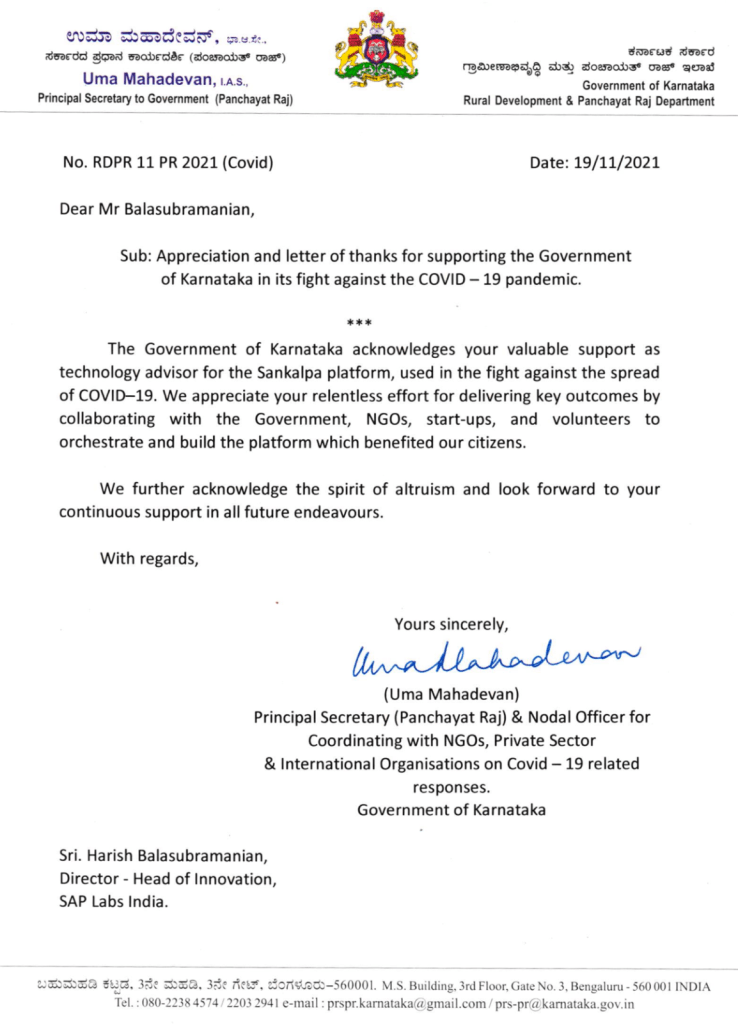
For the work, I received a letter of appreciation from the Government of Karnataka — a recognition I’m deeply humbled by.
What it validated wasn’t just the product. It was the model: that a motivated technology leader, given a clear problem and the freedom to build the right team, can mobilise an ecosystem of unlikely partners and deliver something that genuinely matters — fast, at scale, and under conditions that would have stopped a slower-moving organisation cold.
That, more than any single feature or delivery milestone, is what I hope this initiative stands for.
Have you ever been part of a team that came together around a crisis — and what did it teach you about how good work actually gets done?


 harish.balasubramanian
Share your thoughts