There’s an old investing principle that goes: follow the money, not the narrative. Right now, the money is making a very specific argument — and it’s doing it loudly, in the form of nine-figure cheques written almost exclusively in one direction.
The funding landscape that’s emerging looks less like a rising tide and more like a funnel. Enormous capital flowing toward a small number of bets. And below that, a growing ecosystem of smaller, highly specialised players. The interesting question isn’t why — it’s what this pattern means for everyone who isn’t raising at that scale.
The Barbell Is Widening
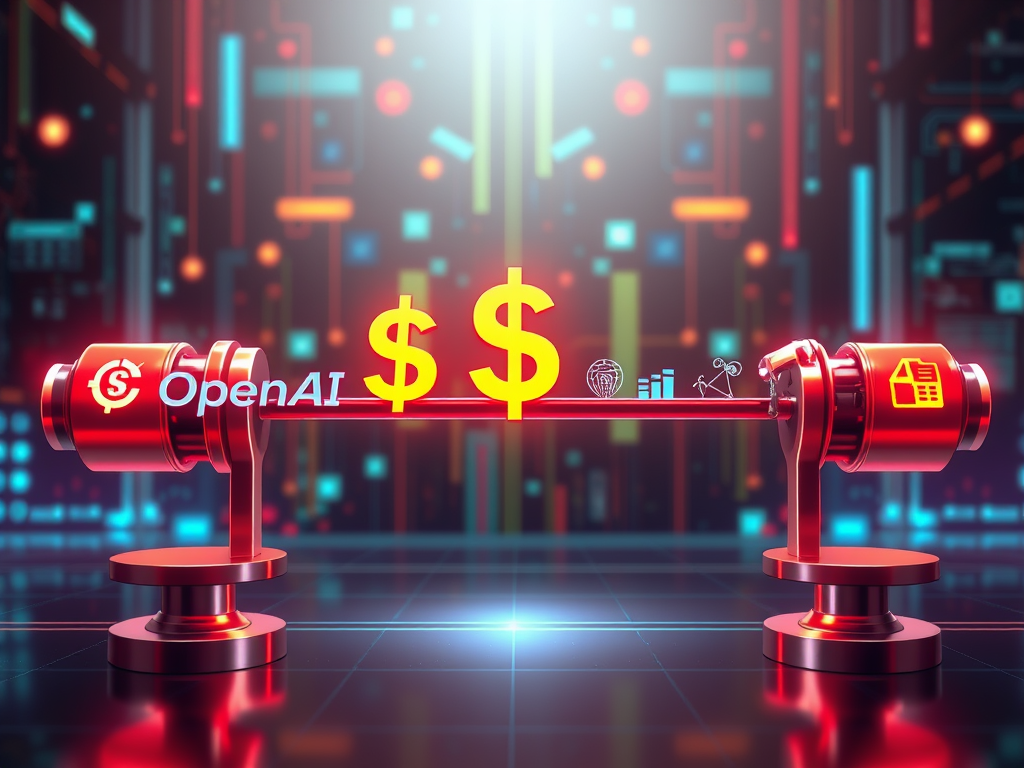
The shape of the current funding environment is worth visualising. Think of a barbell — heavy on both ends, thin in the middle.
At one end: foundation model companies and AI infrastructure players drawing extraordinary capital. OpenAI’s valuation at roughly $80 billion reframed what “large round” even means in this cycle. Anthropic, backed by Amazon and Google in multi-billion dollar commitments, is in the same weight class. These are companies where the capital requirement is structurally enormous — training compute alone demands infrastructure investment at a scale that simply wasn’t part of the startup funding calculus five years ago.
At the other end: specialised, domain-specific AI applications attracting focused investment. Vertical SaaS with AI embedded. Industry-specific models trained on proprietary data. Tools and workflows solving precise enterprise problems. These companies don’t need billions. They need focused capital, a named customer base, and a demonstrably better solution for a specific problem.
The pattern worth noting is that the middle — the moderately-funded, broadly-positioned AI startup with an unclear differentiation story — is where capital is thinnest. The barbell is widening, and standing on the bar itself is becoming an uncomfortable place.
What’s Happening in the Indian Ecosystem
Early signals from the Indian startup market tell a version of the same story.
The deals landing are larger and more deliberate. Fewer, bigger bets — concentrated in companies with clear business models, defensible positions, and meaningful AI integration. The correction of the prior cycle has done something that felt painful at the time but looks more purposeful in retrospect: it cleared the field of undifferentiated companies that were capitalised more on narrative than value.
What’s emerging isn’t a return to 2021 exuberance. It’s something quieter and arguably healthier — a funding environment that rewards conviction over coverage. The conversations happening in investor circles right now are less about portfolio volume and more about portfolio quality. That’s a meaningful shift in posture.
The Structural Logic of Capital Concentration
There’s a reason this pattern keeps repeating across technology cycles, and it’s not conspiratorial — it’s structural.
Foundation models require compute at a scale that makes capital intensity unavoidable. Running, fine-tuning, and deploying models at enterprise grade is not a bootstrappable activity. The infrastructure layer beneath AI — GPUs, cloud capacity, specialised networking — demands sustained investment before a single product ships. When the underlying technology requires this level of capital just to be operational, concentration isn’t surprising. It’s arithmetic.
The analogy that keeps coming to mind is the early telco and semiconductor eras — industries where the infrastructure layer required massive, upfront, long-duration capital before any consumer value could be created. The companies that won those cycles were the ones that either secured the infrastructure capital or found ways to build entirely on top of it without needing to own it. The same fork is appearing in AI, and it’s arriving faster than most roadmaps expected.
The Interesting Territory for Everyone Else
Here’s where it gets genuinely interesting — and where the funding concentration story becomes less about who has the most capital and more about what you do with the capital landscape you’re in.
The organisations and builders not competing for foundation model funding have a specific opportunity: the application layer. Enterprise buyers are increasingly clear that they want solutions to named problems, not platforms requiring them to figure out the application themselves. The ROI conversation that has landed in enterprise AI — explored in the previous post on production deployment — is creating real demand for specialised, proven solutions.
The capital flowing toward the top of the stack doesn’t diminish the opportunity at the edges. If anything, it clarifies it. The lens worth applying here isn’t where is the most capital? It’s where does a specific capability create disproportionate value for a defined customer? That question tends to point away from foundation models and toward the domain-specific, data-rich applications where incumbents have a genuine head start.
What the Pattern Suggests
Capital concentration tells a story about confidence — specifically, where investors believe the durable value will compound. The current story is being told in a very specific accent: AI infrastructure and foundation models at the top, specialised applications in focused verticals at the base.
The mid-market squeeze is real. But it’s also clarifying. In a thinning middle, the companies that articulate a clear position — either as essential infrastructure or as the best possible solution to a specific problem — stand out more sharply than they would in a crowded, generously-funded field.
As the barbell widens, that clarity becomes the most valuable thing a company can have.
As you watch capital concentrate at the extremes — do you think the hollowing of the AI mid-market creates a longer-term risk for the ecosystem, or is it actually the correction the industry needed?
Let’s keep learning — together.


 harish.balasubramanian
Share your thoughts