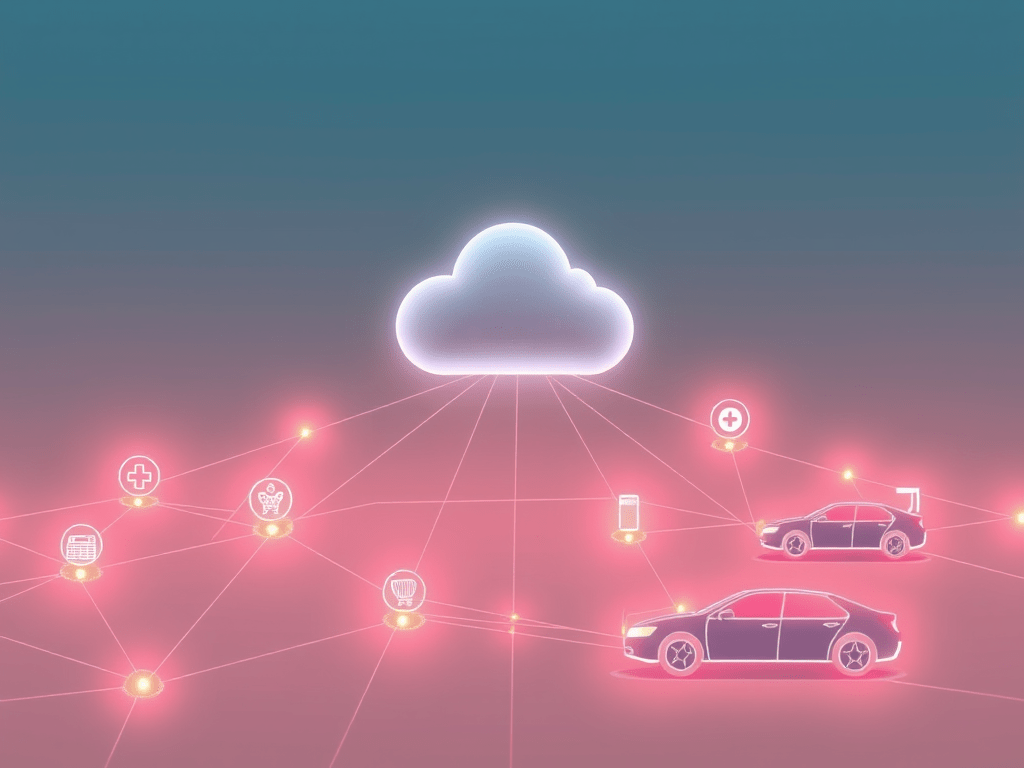
For most of the AI era, the mental model has been consistent: data goes up, intelligence comes back down. You generate something at the edge — a sensor reading, a video frame, a transaction — and it travels to a data centre somewhere, where the actual thinking happens, and the result makes its way back to where the action is. The round trip was acceptable when the action wasn’t time-sensitive. It stops being acceptable when the machine on a factory floor needs to decide in milliseconds whether to stop the line.
That’s the quiet architectural shift happening right now. The intelligence isn’t waiting in the cloud anymore. It’s moving to where the data is created — and the implications run considerably deeper than latency metrics.
What “Edge” Actually Means
The term gets used loosely, so it’s worth grounding it. Edge computing places processing capability at or near the source of data generation — this might be a gateway device in a factory, a camera with onboard processing in a store, a medical device in a hospital room, or a base station in a 5G network. The defining characteristic isn’t where the hardware sits — it’s that computation happens before data makes the round trip to a central cloud.
The result is a cluster of properties that matter enormously in the real world: latency measured in milliseconds rather than seconds; bandwidth costs that drop because you’re sending processed insights instead of raw sensor streams; data that doesn’t leave the premises (which matters greatly in healthcare and finance); and resilience that doesn’t depend on cloud connectivity being up.
Gartner’s projection — that roughly 75% of enterprise-generated data will be created and processed outside traditional centralised data centres — isn’t a distant forecast anymore. It describes what’s being built right now.
The Case Studies Are Getting Concrete
One of the clearest signals that edge AI has crossed from experimentation to operational deployment is what the case studies look like. They’re no longer proofs of concept. They’re running production systems.
In healthcare, Butterfly Network developed handheld AI-enhanced ultrasound devices that process imaging data locally — bringing diagnostic capability to clinical settings where cloud connectivity is unreliable and where the latency of a round trip to a server would be clinically unacceptable. The edge isn’t a convenience here; it’s the only architecture that actually works.
In manufacturing, NVIDIA’s Jetson modules enable real-time quality inspection on production lines using computer vision — detecting defects as products move, triggering diversions without waiting for a centralised decision. Studies across the sector suggest AI-driven predictive maintenance at the edge can reduce unplanned equipment breakdowns by as much as 70%. For an industry where a single hour of unplanned downtime on a major production line can cost hundreds of thousands, that’s not a marginal gain.
The pattern worth noting: 61% of organisations planned to prioritise edge computing investment in the coming year, per KPMG’s 2024 global technology survey. Accenture put the number even higher — 83% of executives describe edge computing as essential to future competitiveness. These aren’t interesting technology conversations. They’re budget conversations.
The AI Angle Is More Interesting Than It Looks
This blog has explored the AI readiness question in some depth — particularly around the data stack and the missing knowledge layer in most enterprise AI architectures. Edge AI adds a new dimension to that conversation.
When AI inference runs at the edge, the model needs to be smaller, more efficient, and more task-specific than the large general-purpose models that do well in the cloud. This is exactly why Gartner projects that by 2027, organisations will be using small, task-specific models three times more often than general-purpose large language models. The edge doesn’t just change where AI runs — it changes what kind of AI makes sense. Compact, domain-specific, fast, and privacy-preserving, rather than vast, general, and remote.
Federated learning is beginning to address one of the more interesting implications of this shift: edge devices can contribute to model improvement without sending raw data anywhere. Each hospital can improve a shared diagnostic model using its patient population’s patterns — without any individual patient’s data leaving the facility. The model gets smarter; the data stays private. That’s a genuinely different way of thinking about AI development, and it’s only possible because the intelligence is at the edge.
The Architecture Challenges Nobody Warned You About
It would be incomplete to describe edge deployment without noting what it introduces on the operational side — because the raw blog is right that the challenges are real, even if the solutions are improving.
Managing hundreds or thousands of distributed edge devices is a fundamentally different problem from managing centralised cloud infrastructure. How do you push model updates to ten thousand cameras across multiple regions? How do you detect when an edge device has drifted — when its local model is producing different results than it should, because the environment it’s operating in has changed? How do you aggregate insights from distributed systems in a way that’s coherent and timely?
The tooling is maturing — Kubernetes-based edge orchestration, purpose-built edge management platforms, over-the-air model update pipelines — but only 15% of cloud-certified professionals currently report confidence in the full stack of skills required: networking, real-time operating systems, and edge fleet management together. That skills gap is real, and for enterprises planning large-scale edge deployments, it’s worth accounting for earlier rather than later.
The security picture also shifts at the edge. Each additional edge gateway is another potential entry point. Insurance premiums for edge deployments reportedly climbed 12% in 2025 as carriers priced in the breach likelihood of distributed, often physically accessible, infrastructure. NIST’s Cybersecurity Framework 2.0 now includes edge-specific controls — which is a useful indicator that the security community is taking this seriously enough to formalise guidance.
The Broader Pattern
Step back from the use cases and the market figures, and there’s a more fundamental observation underneath all of this. The history of computing has been a pendulum between centralisation and distribution. Mainframes gave way to minicomputers and then PCs (distribution). The internet era pulled everything back into data centres and cloud platforms (centralisation). Edge computing represents the latest arc of the pendulum.
What makes this swing different from previous ones is that it isn’t driven by cost or convenience alone — it’s driven by the physics of real-time decision-making. There are things that cannot wait for a round trip. Autonomous decisions on a factory floor. Emergency clinical alerts. Fraud detection in microseconds at a point of sale. The cloud is brilliant for what the cloud is good at. The edge is filling in the gaps that the cloud, by its nature, cannot reach.
The earlier post on agentic AI in enterprise explored what happens when AI starts acting autonomously, not just responding to prompts. Edge is, in many ways, the infrastructure prerequisite for agentic AI in physical environments. An agent that controls manufacturing equipment needs sub-second response times. That’s not a cloud architecture problem — it’s an edge architecture requirement.
In your organisation, where is the decision that genuinely can’t wait — and is the architecture currently capable of making it fast enough?
Let’s keep learning — together.


 harish.balasubramanian
Share your thoughts