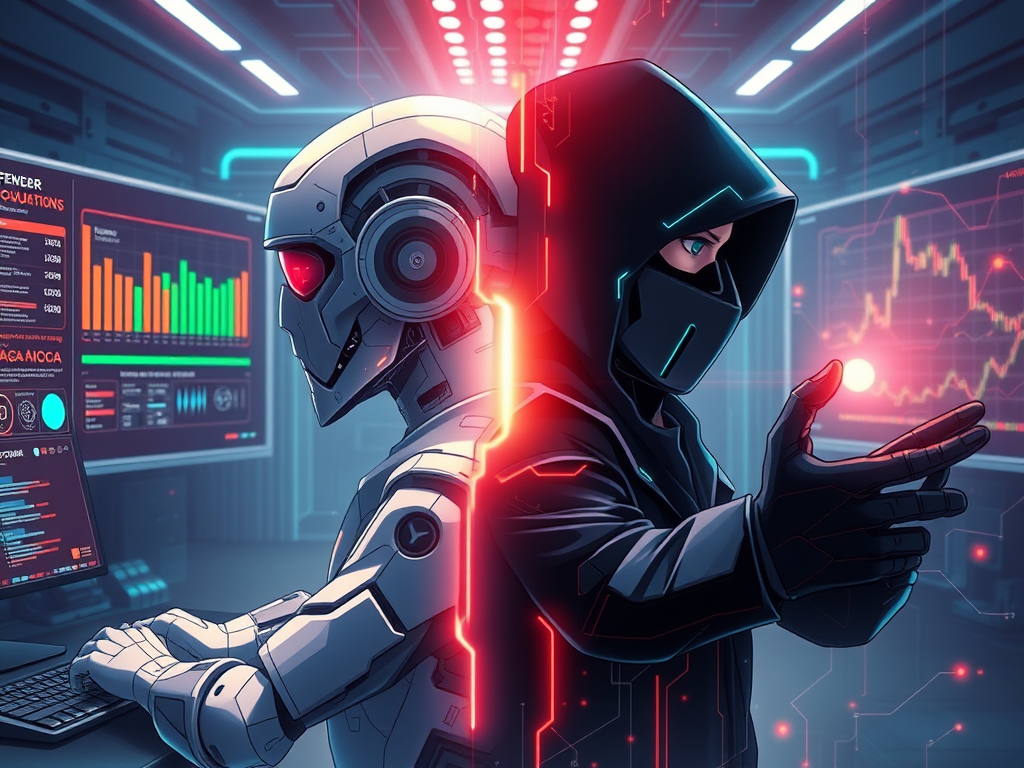
There’s a mental model that most enterprise security teams have quietly held for years: the defender has the tools, the attacker has the creativity. Signature-based detection was, in a sense, a catalogue of creativity that had already happened — known attack patterns, documented, filed, matched.
The uncomfortable shift underway is that AI has changed both sides of that equation simultaneously.
Why Signature-Based Detection Was Always Playing Catch-Up
The logic of signature-based threat detection is essentially reactive by design. A threat has to be seen, analysed, documented, and pushed as a definition update before the system can recognise it. For well-understood, high-volume attack patterns, this works reasonably well. For anything novel, it’s structurally blind.
This isn’t a flaw that better engineering could fix — it’s inherent to the model. Signatures can only identify what has already been named.
AI-driven detection approaches the problem differently. Rather than scanning for known patterns, these systems first build a behavioural baseline — what normal looks like for every user, every device, every application across the environment. Threats reveal themselves as deviations from that baseline, not as matches against a catalogue. The capability this unlocks, formalised as User and Entity Behaviour Analytics (UEBA), is the ability to catch novel, zero-day, and polymorphic attacks that would be entirely invisible to signature tools. In high-risk enterprise environments, AI-driven detection is demonstrating rates as high as 98%.
The Scale Dynamic Is Real — But It’s More Complex Than It Sounds
The raw blog framing that scale advantages favour large enterprises is partly true, and worth unpacking carefully.
AI detection systems do improve with data. More signals, more historical context, more edge cases seen and learned from — the models get sharper over time. Organisations with large, instrumented environments have a genuine head start. But the pattern worth noting is how quickly that advantage is being democratised. Managed Security Service Providers now pre-integrate AI detection capabilities into their offerings, extending behavioural analytics, phishing detection, and lateral movement prevention to mid-market and smaller organisations without requiring in-house data science capability.
The broader headline is that 61% of enterprise security teams have now adopted AI-powered threat detection. Organisations using AI detect threats 60% faster and contain breaches 108 days sooner on average. IBM’s 2025 Cost of a Data Breach report found breach costs running $1.76 million lower for organisations with extensive AI security deployment. The advantage is measurable — and it compounds with time.
The Arms Race No One Wanted
Here is the context the raw framing of “AI security advantage” tends to skip over: attackers have access to the same tools.
AI-assisted attacks have increased sharply over the past year. Phishing, augmented by generative AI, has grown at a scale that would have seemed implausible recently. Polymorphic malware — code that rewrites its own signature using AI evasion logic — now represents a meaningful share of advanced persistent threats. AI-generated social engineering is increasingly difficult to distinguish from legitimate communication.
This is an arms race dynamic, not a one-sided capability shift. The organisations that understand this are not simply deploying AI detection and considering the problem solved — they’re investing in continuous model training, adversarial testing, and the kind of human oversight that keeps the system honest when the attacker’s AI figures out how to look normal.
Which leads to the most interesting question in enterprise security right now.
The Human-AI Partnership in the SOC
The image of the Security Operations Centre being replaced by autonomous AI is probably overstated — and possibly the wrong ambition entirely. The more useful framing is the one actually emerging in practice: AI handles the volume, humans retain the judgment.
At the scale of modern enterprise environments, analysts face alert volumes that no team could meaningfully review without automation. AI filters, correlates, prioritises — reducing noise and surfacing what genuinely warrants human attention. The evidence suggests this partnership works: 68% of organisations report their SOC analysts now handle two to three times more alerts with AI assistance, without corresponding increases in team size.
What AI doesn’t replace — and arguably amplifies the need for — is strategic security judgment. Deciding when an anomaly is genuinely suspicious versus a legitimate edge case. Understanding the business context around an unusual access pattern. Authorising containment actions that have operational consequences. These require human cognition in ways that current AI systems don’t reliably provide.
The architecture thread running through recent posts here — from zero-trust frameworks to AI readiness bottlenecks — keeps arriving at the same underlying point: the infrastructure and the intelligence layer have to work together. AI threat detection sitting on top of a zero-trust segmented architecture is a meaningfully different proposition than AI detection running on a flat, perimeter-based network. The layers compound each other.
What the 29% Figure Actually Means
One data point worth sitting with: even among organisations that have deployed AI-powered defences, 29% still suffered AI-based breaches in the past year. That is not a refutation of AI security — the alternative is considerably worse. But it is a useful corrective to any narrative that frames this as a problem that AI solves.
The honest diagnosis is that AI detection is a critical and increasingly indispensable layer. It is not a ceiling. The organisations building for the next stage of this arms race are the ones treating it as one component of a continuously evolving security posture — not as a destination.
The concept has matured. The implementation race is very much still on.
As AI strengthens both attack and defence simultaneously, where do you think the next genuine vulnerability gap opens — in the technology, the people, or the processes surrounding both?
Let’s keep learning — together.


 harish.balasubramanian
Share your thoughts