
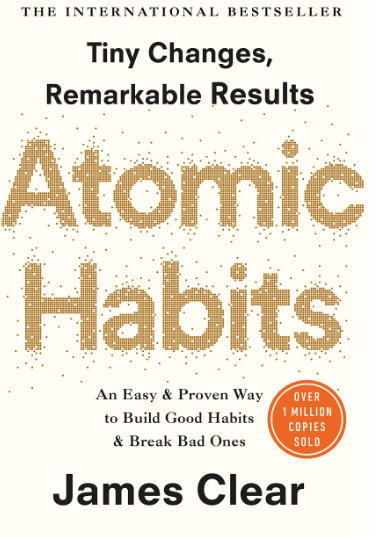
I’ll be honest — I almost didn’t pick this one up. The title felt like it belonged next to a motivational poster in a dentist’s waiting room. Atomic Habits. It sounds like the kind of book that promises to change your life in twelve steps and features a sunrise on the cover.
But somewhere around chapter three, something clicked. James Clear isn’t really writing about habits at all. He’s writing about identity — and habits are just the mechanism. That reframe changed how I read the rest of the book, and quietly changed how I think about behaviour change in general.
Here’s what stayed with me.
Small Is Not the Same as Insignificant
The book opens with a deceptively simple idea: a 1% improvement every day compounds into being 37 times better over a year. A 1% decline every day compounds into being almost nothing. The maths is real; the implication is unsettling.
We’re wired to dismiss small actions. Five minutes of exercise feels pointless. Reading ten pages a day feels like rounding error. But Clear’s point isn’t that any single small action matters — it’s that the direction matters enormously, and small actions are how you establish a direction. The British Cycling team that went from irrelevance to domination under Dave Brailsford did it through what he called “the aggregation of marginal gains” — tiny improvements in sleep, nutrition, bike maintenance, even the type of pillow riders used. No single change was the breakthrough. All of them together were.
You Don’t Rise to Your Goals. You Fall to Your Systems.
This line hit me harder than most. We’re obsessed with goals — quarterly targets, annual reviews, personal resolutions. But Clear argues that goals are essentially useless for determining outcomes. Two athletes can have the same goal of winning a race. One wins, one doesn’t. The goal didn’t differentiate them. The system did.
I’ve seen this in practice more times than I can count. Teams with ambitious goals and no supporting rhythm for how they work — no regular review, no feedback loops, no habit of learning — almost always underperform teams with modest ambitions and excellent daily operating practices. The goal tells you where you want to go. The system determines whether you get there.
The Four Laws (and Why “Just Trying Harder” Isn’t One of Them)
Clear’s practical framework is built around four laws of behaviour change. To build a good habit: make it obvious, make it attractive, make it easy, make it satisfying. To break a bad one: invert each. Make it invisible, unattractive, difficult, unsatisfying.
The “make it easy” law is the one I think gets most underestimated. There’s a concept in the book called the Two-Minute Rule — if a new habit takes longer than two minutes, it’s too complicated to start with. Want to read more? The habit isn’t “read a chapter every night.” It’s “open the book.” Want to exercise more? The habit isn’t “go to the gym.” It’s “put on your gym clothes.”
It sounds almost insultingly simple. But the insight underneath it is real: most habits don’t fail because we lack motivation. They fail because the activation energy required is higher than what we can reliably generate at the end of a long day. Reduce the friction, and the behaviour follows.
Identity Is the Lever Nobody Talks About
Here’s what I think is the most underrated idea in the whole book — and the one that reframes everything else.
There are two ways to try to change a habit. The first is outcome-based: “I want to lose weight, so I’ll exercise.” The second is identity-based: “I’m someone who values their health, so I exercise.” Clear argues the second approach is vastly more durable, because the behaviour is now an expression of who you are — not just a means to an end.
Every time you act consistently with a new identity, you cast a vote for that identity. Miss once — no problem. Vote against yourself occasionally — that’s fine, it’s part of being human. But the pattern of votes over time is what builds the belief, and the belief is what sustains the behaviour when motivation runs out. Which it always does, by about the third week of January.
This felt important to me beyond the personal habits context. Teams and organisations have identities too. A culture of “we ship fast and fix later” produces different default behaviours than a culture of “we build it right the first time.” Neither is universally better — but both are self-reinforcing once established. Change the culture, and you change the default habit loop for hundreds of people simultaneously.
The Habit Loop You’re Already Running
The four-step loop at the centre of the book — cue, craving, response, reward — is the mechanism behind every habit, whether you designed it or not. The phone notification (cue) triggers a vague pull toward distraction (craving), you check the app (response), you get a small dopamine hit from whatever you found (reward). Repeat ten thousand times, and you’ve got a habit no one consciously installed.
What’s useful about naming the loop is that it tells you where to intervene. If you want to break a bad habit, you don’t need to attack all four steps — just make one of them harder. Hide the cue. Add friction to the response. Remove the reward. The loop falls apart.
And if you want to build a good one: design the environment so the cue shows up reliably, anchor it to a craving you already have, make the first response tiny, and celebrate just enough to signal that it was worth doing.
What I Took Away
Atomic Habits is, at its best, an argument for designing your environment more carefully than you design your motivation. Motivation is weather — unpredictable and temporary. Environment is architecture — it shapes behaviour whether you’re paying attention or not.
The habit I started after reading this book was embarrassingly small. But it stuck. And that, more than any of the theory, was the proof of concept.
Which of your current habits — good or bad — would you say was deliberately designed, and which one just… accumulated?
Let’s keep learning — together.


Share your thoughts