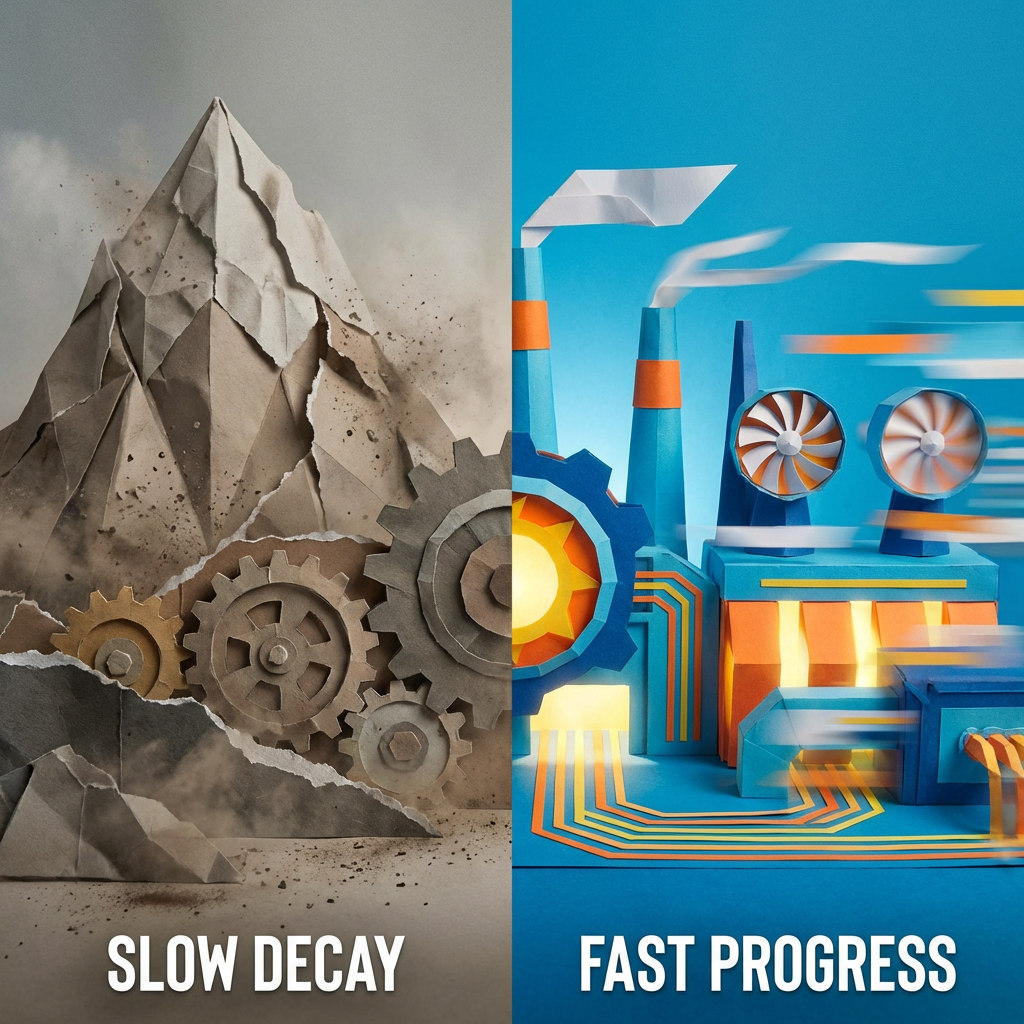
There’s a quiet assumption baked into most strategy meetings: that innovation is fundamentally about ideas. The team with the sharpest product instinct, the most creative pivot, the boldest bet — they win.
Except that’s not quite the pattern that’s emerging.
What’s showing up across industries is something more nuanced — and frankly, more actionable. The organisations winning the innovation race aren’t necessarily the ones with the best ideas first. They’re the ones who can cycle through ideas fastest. Hypothesis, test, learn, ship, repeat. And then do it again before the competition has finished their first review cycle.
Speed Is the Structural Advantage
Composable architecture implementations consistently report 30 to 70 percent reductions in deployment times. Composable data architectures are showing 40 to 60 percent faster delivery of new capabilities. When you sit with those numbers, the compounding effect becomes hard to ignore.
Think about what that means over a twelve-month horizon. An organisation running weekly innovation loops completes roughly 52 experiments per year. One running quarterly loops completes four. That gap isn’t just about speed — it’s about how much each organisation actually learns. The fast mover banks more signal, more feedback, and more compounding knowledge per year. The slower one isn’t just behind; it knows less.
The pattern worth noting: speed of cycle isn’t a tactic. It’s a compounding mechanism. And compound advantages don’t just widen over time — they accelerate.
Three Practices Behind the Fast Movers
Hypothesis-Driven Development
The shift from “build it and see” to “what do we need to learn, and what’s the cheapest way to learn it” — that reframe changes everything. Hypothesis-driven development treats every product initiative as a falsifiable experiment. Teams aren’t just moving faster; they’re wasting less. Fewer zombie features. Fewer quarters of engineering effort shipped to nobody.
The question isn’t whether the idea is good. It’s: what would have to be true for this to work, and how quickly can we find out?
Continuous Improvement as Operating Rhythm
The organisations compounding their innovation speed aren’t treating iteration as a project phase. They’ve made it the operating model itself. There’s a thread worth revisiting from earlier in this series on Kaizen and AI — the observation that Kaizen was never exclusively a manufacturing philosophy. It was always about eliminating friction in any system. What modern infrastructure now delivers is the ability to run that rhythm at software velocity, continuously and without intervention.
Agile Governance
Here’s the irony that most slow innovators quietly know but rarely say out loud: it’s rarely the engineering teams holding things up. It’s the approval layers, the risk committees, the governance structures designed for a release-every-six-months world.
Agile governance doesn’t mean removing oversight. It means designing oversight that can actually keep pace with the business. The difference, in practice, is measurable in weeks per release cycle.
The Infrastructure Gap Is Quietly Becoming a Chasm
The organisations moving fast aren’t doing it through culture or ambition alone. They’ve built the scaffolding underneath ambition.
Cloud-native platforms. Automated testing pipelines. Continuous deployment. Composable data layers. These aren’t purely technology choices — they’re operating tempo choices. Gartner’s research points to organisations adopting composable approaches outpacing competitors by 80% in digital delivery speed. That’s not a marginal edge. That’s a different tier entirely.
And here’s what makes this structural rather than cyclical: every iteration cycle widens the gap. Fast movers bank more learning per year. Slower organisations aren’t just behind — they’re losing ground at an accelerating rate. The composable architecture and living enterprise architecture threads from earlier in this series are worth reading alongside this one — the infrastructure discussion connects directly to what makes the acceleration possible.
The signals worth watching for in lagging organisations are familiar: releases that take months to ship, change requests queuing behind legacy integration work, data pipelines requiring manual intervention before anyone can run a single experiment. These aren’t technical symptoms. They’re rhythm symptoms.
The Pattern Worth Watching for Founders
The infrastructure gap is both a problem and a positioning opportunity for founders building for enterprise.
Enterprises that can’t yet move fast aren’t lacking ambition. They’re often lacking the scaffolding that makes ambition executable at speed. The AI-native startup thread from earlier in this series touched on a similar distinction — the difference between organisations that retrofitted modern thinking onto legacy processes and those that rebuilt the foundation. The same logic applies here.
The founders who help enterprises build genuine innovation infrastructure — not point solutions, but the compounding machinery — are the ones finding traction that holds. Not because it’s a compelling story, but because the competitive pressure to close the infrastructure gap has become inescapable.
What’s actually holding your organisation back from moving faster — the ideas, or the speed at which you can test them?
Let’s keep learning — together.


 harish.balasubramanian
Share your thoughts