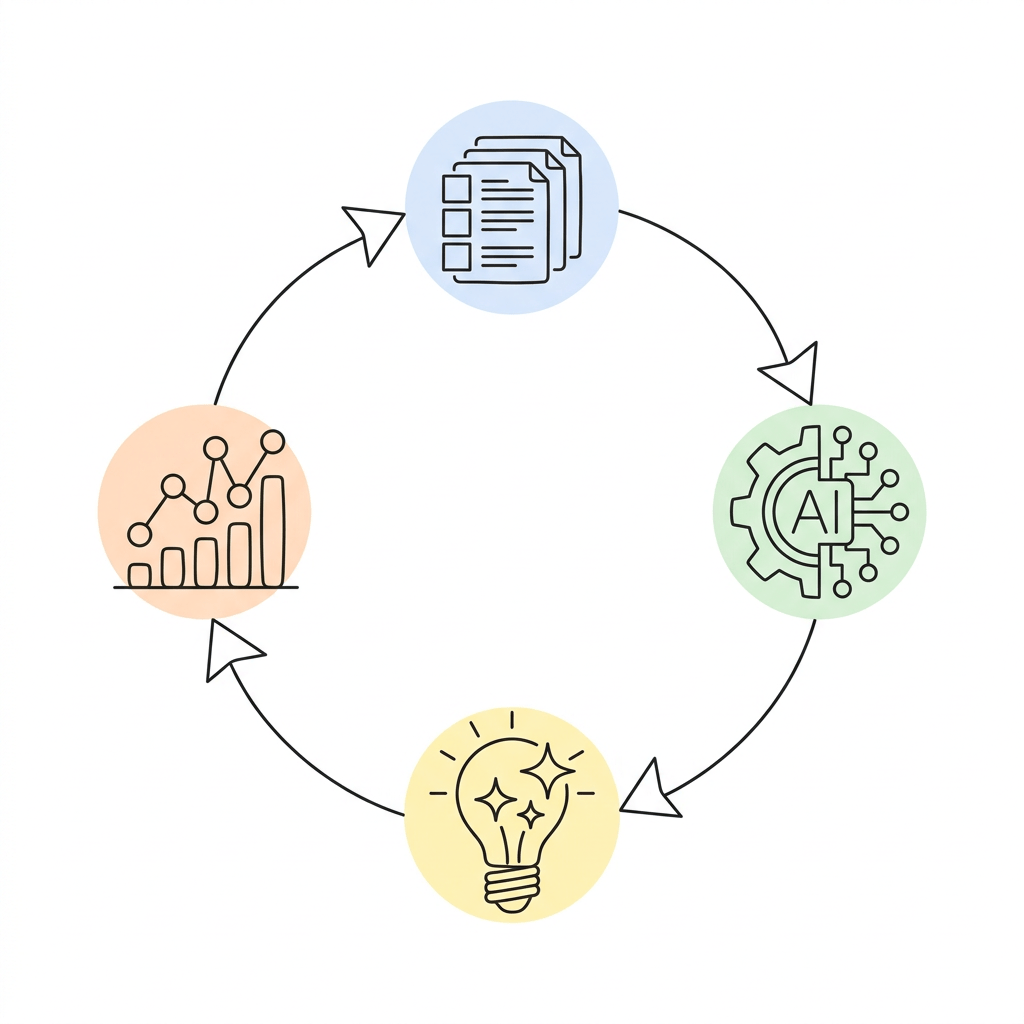
Here’s a question worth sitting with: when your AI model gets better, where does that improvement actually come from?
The easy answer is “better algorithms.” The more honest answer, for most organizations, is messier — and it has less to do with the model and more to do with what’s feeding it.
The Loop Nobody Draws on the Whiteboard
Picture four stops on a circle: cleaner data leads to a sharper AI model. A sharper model leads to a better business decision. A better decision creates new data — richer, more structured, more worth capturing than what came before. And that new data feeds the next round.
It’s a loop, not a line. And like any loop, it compounds in whichever direction it’s already moving.
This isn’t a new idea dressed up in AI language. It’s the old manufacturing principle of continuous improvement, wearing a different uniform — a theme worth revisiting from Kaizen Never Sleeps, where the interesting shift wasn’t the improvement itself but how continuous “continuous” had actually become.
What the Numbers Are Actually Saying
A recent industry survey of hundreds of operations leaders found that the overwhelming majority say poor data quality has hampered their ability to get value from digital and AI initiatives. Only a small fraction report that their data quality has meaningfully improved in the past few years.
That’s the uncomfortable middle of the loop — where most organizations seem to get stuck. Not because nobody wants better data, but because the loop only compounds once it’s actually closed. A model trained on unreliable inputs doesn’t produce decisions good enough to generate better data next time. The circle just… stalls.
Interestingly, the same survey found a small cohort of organizations — the ones who report AI fully embedded, data foundations modernized, and operating models redesigned together rather than separately — also report the strongest gains in data quality itself. Correlation isn’t the same as proof of cause. But it’s a pattern worth noting: the loop and the discipline to close it seem to travel together.
Why This Connects to the Data Conversation We’ve Already Been Having
This isn’t a standalone observation. It sits right next to the question raised in Your AI Is Only as Good as the Data You’re Too Embarrassed to Look At — where the uncomfortable finding was that a majority of organizations don’t fully trust their own data, even while building AI on top of it.
And it echoes the tension in AI Trust Is Falling While AI Use Is Rising — trust and quality aren’t separate problems. They’re the same problem showing up in two different conversations.
The feedback loop is really the mechanism underneath both. Trust doesn’t get rebuilt through a memo. It gets rebuilt one closed loop at a time.
The Enterprise Angle: This Is Where GCCs Quietly Win
There’s a particular version of this loop playing out inside Global Capability Centres. GCCs often sit closer to the operational data — the transaction logs, the customer service records, the shop-floor sensors — than the headquarters teams setting AI strategy from a distance.
That proximity is an underused advantage. The lens worth applying here: the feedback loop closes faster when the people managing the data and the people acting on the AI’s output aren’t three time zones and two org charts apart.
The Conversation Worth Having
Nobody sets out to build a broken feedback loop. It usually happens by accident — a data quality project gets deprioritized, an AI pilot ships without proper measurement, a decision gets made and nobody captures what happened next. Each gap seems small. Together, they’re the difference between a system that compounds and one that just repeats.
So here’s the question worth asking inside your own organization: at which of the four stops — data, model, decision, or capture — does your loop actually break?
Let’s keep learning — together.


Share your thoughts